Inspiration #6
They say there’s a place where dreams have all gone
They never said where but I think I know
It’s miles through the night just over the dawn
On the road that will take me home
I know in my bones, I’ve been here before
The ground feels the same though the land’s been torn
I’ve a long way to go the stars tell me so
On this road that will take me home
Love waits for me ’round the bend, leads me endlessly on
Surely sorrows shall find their end and all our troubles will be gone
And I’ll know what I’ve lost and all that I’ve won
When the road finally takes me home
And when I pass by, don’t lead me astray
Don’t try to stop me, don’t stand in my way
I’m bound for the hills where cool waters flow
On this road that will take me home
~ Mary FahlÂ
All through my life these words have followed me, and sometimes I find myself repeating them due to the comfort they bring. Hopefully we will find this place, or at least have something closest to it, that we can call home.
Inspiration #5
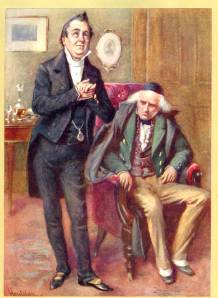
“Martin Chuzzlewit”- The Dark Horse of Dickens?
Described by Dickens as “in a hundred points immeasurably the best of my stories”, we come to the 7th of his novels, “Martin Chuzzlewit.” Unfortunately, the general public didn’t seem to agree about it being the best, so it has always remained low profile.
You can argue it’s  natural and typical-an author’s pride, joy and dear baby never seems to be appreciated by others quite as much as they themselves do. So we can feel for Dickens.
1) The themes explored in the novel include murder, satire, deception, selfishness, selfishness and more selfishness. (some are not very nice people).
2) The protagonist Martin travels to America to a colony situated in a swamp, he becomes very ill,  is at the brink of death and sinks into a period of ruin and despair. Despite his hardships, he becomes much improved by the time he returns to Britain, with the aid of his very optimistic and jolly friend Mark Tapley.
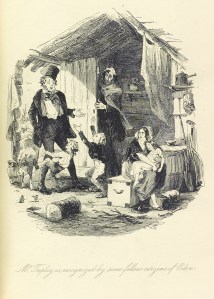
3) It illustrates Dickensâs turning point towards the darker threads of human nature and refinement of his writing style, comparing the satire and humour of “Nicholas Nickleby” against his later novels such as “Tale of Two Cities”, “Our Mutual Friend”, “Great Expectations” and “Bleak House”.Â
4) Dickens portrays America in a poor light; âdeface the banner of the nation for an idle rag, pollute it star by star, and cut our stripe by stripe as from the arm of a degraded soldier.â Offensive to many of his American readers? It seems the novel and its characters are quite biased in regards to Dickens’s first visit to the country. He must have had a really bad experience….
Our Mentionable Characters:
- Mr Pecksniff and his hypocrisy. He is a character you are itching to strangle. Even the online dictionary has an entry in his honour. Pecksniffery/Pecksniffian: adj- affecting benevolence or high moral principles.
- The admirable Tom Pinch who puts others needs before his, humble and loyal. Everyone’s friend. You want to wrap him up in cotton wool and keep him safe. But without the juxtaposition of other villains and the unfair trials Tom must bear, his positive qualities cannot shine through.
- Â Martin is not the focus. He is weak minded, sometimes fickle and lacks a commanding personality despite his improvement later in the novel. An interesting question is how he is comparable to Dickensâs other protagonists?? Oliver Twist, David Copperfield, even Nicholas. (yes it has come to a point where I am on a first name basis with him)
- Mrs Gamp. Described as a “drunken and verbose” nurse, she provides much comedic relief to the story. Honestly, the things she says hardly makes sense, but she is reliable and does her job well. That’s all we need to know.
5) Perhaps you need to be a die-hard fan to be motivated to finish this novel. It is quite wordy and so dedicated reading is a must, to pick up from where you left off. Maybe one day I will give it another chance from the beginning! Though it took me a lot longer to complete, nevertheless- I did enjoy it and will be sad when my collection of Dickens is finished! I console myself that there is yet “A Tale of Two Cities” to go…

Inspiration #4
“Once upon a midnight dreary, while I pondered, weak and weary,
Over many a quaint and curious volume of forgotten lore â
While I nodded, nearly napping, suddenly there came a tapping,
As of some one gently rapping, rapping at my chamber door â
“‘Tis some visitor,” I muttered, “tapping at my chamber door â
Only this and nothing more.”
*
“Ah, distinctly I remember it was in the bleak December;
And each separate dying ember wrought its ghost upon the floor.
Eagerly I wished the morrow; â vainly I had sought to borrow
From my books surcease of sorrow â sorrow for the lost Lenore â
For the rare and radiant maiden whom the angels name Lenore â
Nameless here for evermore.”
~Stanza 1&2, from The Raven – Edgar Allen Poe
Inspiration #3
Denial, my best friend
burrows under my skin like the larva
of an impending heartache.
I catch myself in the guilty act of a laugh,
a smile- and admonish myself for forgetting
the scales held in the balance.
Still the imposing vulture follows
unabated
with his slanting grin reeking of darkness.
To be sure the judgement will come
one day
but for now little one, stay strong
Stay strong…
Copyright Š 2014 by Kate W J White (All Rights Reserved)
Inspiration #2
“Every book, every volume you see here, has a soul. The soul of the person who wrote it and of those who read it and lived and dreamed with it. Every time a book changes hands, every time someone runs his eyes down its pages, its spirit grows and strengthens.”
â Carlos Ruiz Zafon, The Shadow of the Wind
Inspiration #1
Wind On Fire Series & Book signing!?
For us 90’s kids, this will bring back memories. Memories of fantasy trilogies, memories of Philip Pullman’s “His Dark Materials”…
William Nicholson came to my secondary school for a casual book signing in yr 9- it seemed not many people had heard of him at the time and around 6 people showed up. (Me being the book nerd even then) I figured I was in the minority. He didn’t become my favourite teen author until some time after, so in hindsight, boy am I glad I went ~ Fan girl moment!~
Each book in the trilogy is so different. They can exist independently, or as one long story. They leave you with a strange, dreamy feeling. It takes place in a world that could be our own. In an unknown country, a society tucked away; a city within a city, people so like us and yet live in under such different circumstances. It is this which is so appealing. William Nicholson has an amazing way of establishing a premise for his novels, a world with its own lore that provides a perfect escapism for the reader. In fact, reading the second novel âSlaves of the Masteryâ you may think it shares many similarities with Gladiator, with the shadow of a coliseum, fights, spell binding dances and hard weary travelling through dusty terrain. And there’s a reason for this. Wait for it….the author is actually the screen writer for âGladiatorâ, âLes Miserablesâ and âFirst Knight”.
So not only is he a screenwriter, but he’s also a playwright and novelist! However, something I wondered about- the trilogy was never made into a film. Though the books had the potential to be made for the big screens, I’m glad it wasn’t. There are so many books ruined by films that even the authors themselves have come to despise all that their hard work, sweat and passions had gone into. Of course, this isn’t ALWAYS the case.
So what happens in the books? Read on to find out…
âIn the walled city of Aramanth, exams are everything. When Kestrel Hath dares to revel, the Chief Examiner humiliates her father and sentences the whole family to the harshest punishment. Desperate to save them, Kestrel learns the secret of the wind singer and she and her twin brother, Bowman, set out on a terrifying journey to the true source of evil that grips Aramanth.â
They go underground and meet mud people, have desert battles aboard fierce ships swept by the winds, defeat an army of beautiful and captivating Zars bent on destroying all in their path, all the while trying to escape old children whose touch will turn them old and frail. So, a lot happens.
There is a five years gap between the first and the second book, and the twins (of about 10 or 11) are kids no longer…
âSlaves of the Masteryâ
âWhen the ruthless soldiers of the Mastery strike, the city is burned and its people are taken into slavery.â The twins Kestrel and Bowman are separated and she vows revenge. Kestrel is a spirited character, bold and energetic- a kid who never does what she’s asked and a bit of a trouble maker (as shown by the first book!) whereas her brother is quiet and reflective, and has astounding abilities of empathy. (and later, mind reading) Â The characters have grown up, and are no longer children and you as the reader follow them on this journey. As action packed as the first book was, the second is on a larger scale, think Lord of the Rings with epic battles…
“Firesong”
Now we get to the final instalment which is perhaps my favourite, though the most frustrating. The characters are in search of their homeland through ice â to face starvation, blizzards and kidnapping by bandits as well as encountering mind control. This book is a coming of age story, the young, happy go lucky kids in the first book are young adults now, who face very adult fears and concerns. Fear over losing a parent, of unattainable goals, of illness, death and sacrifice. They must all make important decisions.
It made me feel a range of emotions. When I first read it I wasn’t satisfied with the ending, it made me angry. But I think that’s the point of it. To make you feel a range of emotions, happiness, sadness, fear and anger; to think about your own life. The ending wasn’t perfect, and it took me a while to realise that was okay. That’s real life.
*SPOILER ALERT*
The most important thing I learnt from the ending was about faith. Bowman has a blind, almost spiritual faith to guide them to the homeland, a faith in the good of humanity and that good will defeat evil. Kestrel on the other hand, a sceptic from start to finish often has opposing views. She feels helpless and isolated when her brother slowly starts to distance himself from her.
So what initially confused me, is what does happens to Kestrel? It seems each character has a part to play and Kestrel realises she must sacrifice herself, in order to purge the world of the Morah- the evil that spreads across the land. It is through faith in the greater good. But, there is a part of her that lives in the mind of her twin brother, Bowman. I always had the idea that Kestrel and Bowman would remain together- they understood each other and were each a part of the other, with the ability to communicate without speaking. For some reason, the idea of them separating was heartbreaking, and at the time I didn’t understand why they would have to go through life independently, or even, why one had to go away.
The plot lines are extremely memorable and unique, and very imaginative. SO much happens and yet it all links together perfectly and manages to maintain its simplicity. I imagine the books to represent the elements. The city of Aramanth in the first as earth, the second as fire and destruction, the third air and ice.
They are one of those books that become part of your childhood, growing up with a story that contributes to your concepts and your ideas and if powerful enough- actually form the basis of who you are/will be as an adult.
That’s why children’s and teen books are so important for providing a positive message.
So let me know what you thought of the books, if you have read them or would like to.
If you had 5 minutes with the author, what would you say, or ask?