I always loved “The 3 Musketeers” and “The Count of Monte Cristo” is another by Alexandre Dumas. It’s a powerful book about loyalty, commitment, determination, strength of spirit, of seeking justice and yet not giving up hope. And along with that, if you like sword fights, revenge, disguises, deception, then it’s right up your alley!
“Life is a storm, my young friend. You will bask in the sunlight one moment, be shattered on the rocks the next. What makes you a man is what you do when that storm comes.”
No truer words said! As the main character finds out, he finds his ‘truth’ in the most unexpected way, through the people he meets that come into his life only briefly and teaches him something at the moment he needs it the most.
Edmond Dantes is unjustly framed for treason and sent to a prison fortress for 14 long years. A fellow prisoner is able to teach him all he knows, to figure out his purpose and to plan his vengeance on his duplicitous ‘best friend’ who stole is life, and love. With the secrets to the treasure of Monte Cristo, he is able to re-instate himself in society as the mysterious Count, surrounded by wolves in disguise, he learns to keep his enemies close….
So, no matter what, we must endure. Nothing is perfect in life or happens as we expect, it’s about our mindset when we face disappointment and adversity, and how we act that counts.
*
“When you compare the sorrows of real life to the pleasures of the imaginary one, you will never want to live again, only to dream forever.”
I’ve probably analysed all adaptions to death in my previous post, but here’s another update! (This doesn’t help the ‘nerd’ image in the slightest…)
*spoiler alert*
So what comparisons can we make?
This movie takes the darkness of the Russell Crowe version, combined with the humour of the TV show (Marian looks the spitting image of Lucy Griffiths). It delivers the action, the evil, and combines it with a lot of assassins creed. Riding horseback over rooftops, shooting 100 arrows a second, their modern outfits, buildings that look more eastern than medieval 🏰 … we know how unrealistic this is going to be, but that’s also what keeps us riveted to the screen. It isn’t going to be accurate. But we also know that RH didn’t exist in his ‘current form.’ RH is a great bowman, (my jealousy knows no bounds) and if nothing else, it’s good to have a heroic figure to believe in.
John takes over Azeem’s role in ‘Prince of thieves’, that of mentor and companion, Will Scarlet actually becomes the new sheriff (bet you didn’t see that coming!) There is no gang, at least not without a beginning and each has a story to tell. The dynamics have shifted between them, and they’re not the beloved characters you remember them to be.
The concept of RH to me isn’t just the rich robbing to give to the poor. It’s about the idea of justice, of doing what’s right, and caring for those around you. It might seem two dimensional, (he is a killer, and surely has done some terrible things during the crusades. Isn’t stealing from the law equally as deplorable?) But to this day, and what makes it such a popular legend to portray, is that it shares some important qualities~ of staying loyal (Robin & Marian throughout the time he’s at war), of friendship (in this case striking a bond with those you fight/ work alongside and having a common cause), fairness and sacrifice- death seems but a notion, if its fighting for what you believe in/ those you love.
Yes all versions have a bleak view on the corruptness of the church. The crusades were dark, horrific times and nothing is pretty about heads being lopped off, or peppered by a thousand arrows. They fight for a cause directed by another’s hand and it’s only upon his return home does RH realise the corrupt villains at his own door.
So isn’t he justified in taking action? To strike at the root of evil? No matter what face he wears over the years, he represents an ‘idea’, to stand up against tyranny.
All along it seems a tug of war between RH and the sheriff, of deception, both equally dependent on the other. So it’s interesting to see their relationship throughout the process.
For this movie, RH keeps his personae as robin of Loxley (rich Lord of the Manor) as well as his doppelgänger Robin of the hood. His disguise is never doubted and the sheriff trusts him all too easily. Which is what makes it so intriguing. You’re always waiting for that moment when he’ll be found out.
So what if you found a role reversal, with RH as the villain, the sheriff as compassionate, albeit flawed man caught between his duty & personal affairs who isn’t fixated on capturing Robin Hood at all but merely surviving and protecting his family-what then? 🤔
Overall, it did fulfill what I can only describe as the RH ‘criteria’ and pay homage to the essence of what he represents. The true core of it stays the same, no matter how modern or glitzily revamped the adaptations are. It’s easy to be a critic of the movie, but the reason it stays in people’s minds is down to one thing. Whether he existed or not, he’s been turned into a household name that inspires courage and imagination through the years … and that’s the true legend of Robin Hood.
The narrative voice, as one who unravels a story to the reader; is interesting to explore as it bring a unique perspective to the novel. In this case, the narrative voice of Death acts as a director of the lives he witnesses, a storyteller masking the misery during the Holocaust and the suffering of the Jews during WW2 through the simplicity of storytelling. “The Book Thief” takes the form of a Meta-fictional style, the act of writing becomes the subject; of which the character of Death capitalises on the “truth” blending fiction and reality through irony and self reflection. In the text, the narrator reflects on the capability of humanity and mankind’s ability to be simultaneously beautiful and destructive; characteristics which often puzzle and surprise Death.
Death is an omnipresent and omniscient force whose job is to collect souls; it is humanised and displays a vulnerability and sentimentality of spirit. The question is put forth to the reader; what if Death can possess the ability to feel and care for the lives of those it witnesses? As the narrator itself claims, “the human heart is a line, whereas my own is a circle, and I have the endless ability to be in the right place at the right time. The consequence of this is that I am always finding humans at their best and worst. I see their ugly and beauty and wonder how the same thing can be both.”(p.491) It is through the narrative voice which brings our attention to the nature of mankind and teaches us to observe what we as humans are capable of; and the possible consequences of our choices in life.
It points out it is often misconstrued as a stereotypical being, a Grim Reaper figure with a cloak and scythe. Cynically, it continues, “You want to know what I truly look like? I’ll help you out. Find yourself a mirror while I continue.” (p.307) Though this is metaphorical, it brings to the reader’s attention how Death is within all of us, our fears, hopes. The concept is all around and part of us, it is something we should not be afraid of. So what shapes our view of Death? Is it shaped by what we see in the media, as shown by the vision of the Grim Reaper, or by our experiences? From an early age, our first experience of Death is perhaps through the loss of a pet. If a pet dies, parents struggle with how best to share this information in a way which will not horrify or scar the child, as it is something which will remain in their experiences for years to come. For us all, death is equated with sadness and pain so it is no surprise we are scared of it. “Those kinds of souls always do – the best ones. The ones who rise up and say “I know who you are and I am ready.” (p.532) The narrator, though direct and frank in its choice of words; illustrates to the reader the familiarity it has with humans, like meeting a close friend. There is a comfort in that, it is familiar with its occupation and therefore imparts to the reader the lessons and inevitability of life to soften the transition.
“The Book Thief” (2013) Liesel and Rudy race each other
Death often refers to Liesel as the “Book Thief” in the novel. The title of the novel is dedicated to her. So what is the significance? The reason for this is her love for stealing books. In the case of Liesel, not only is stealing a representation of a girl’s defiance against adversary and the influence of the Nazi regime but she is taking her education into her own hands.
So is it acceptable to steal something if it is abandoned, or left to burn? As children we are taught to treat books with respect, to assign value to words. Nowadays we live in a society which relies predominantly on technology. In the West, there is still a focus on reading for pleasure, yet less and less children have the motivation or desire to read storybooks, especially ones that do not contribute to schooling. So how do we encourage kids to read and share their love of reading with others? Like Liesel it can be a very special and personal experience. For her, it is the thrill of stealing something back- everyone has their own motivation, the conscious act of choosing their first book and their sense of achievement when they finish it. Through a Russian Doll effect, of a story within a story, the narrator Death has a unique ability to reignite the passion to read, the act of picking up a book and feeling its spine, the letters on the cover. Each book is different, just like each individual in the world. Perhaps it is this love and treasuring of words that makes Liesel’s actions more acceptable to the reader; after all, Death does not judge Liesel for her acts of stealing but regards her determination with pleasant surprise.
Liesel in the neighbour’s library
A history lesson
Death can be considered a very unlikely narrator giving a history lesson to children in the text. Comparable to the autobiography “Anne Frank: The Diary of a Young Girl” from a Jewish girl’s perspective, “The Book Thief” focuses on a German girl’s point of view. Though this is a novel, many children today live similar lives to Liesel; orphans, homeless, starving in the backdrop of war. Death serves as the omnipresent and omniscient voice that as a reader, we do not doubt, focusing on children and how war impacts on them. The world is watching events unfold in the past, yet do we learn from our mistakes? Is history repeating itself? The narrator wishes to highlight on this important point, encouraging the reader to think and, as mentioned above to form their own opinions on what is right and wrong. In fact, the narrator believes: Living a good or bad life is its own reward or punishment.
“The Book Thief” (2013) Liesel & Hans
Language to convey meaning
Another point to discuss in relation to Death’s narrative voice is the understanding of the structure of language to convey meaning, “the words were on their way and when they arrived, Liesel would hold them in her hands like the clouds and she would wring them out; like the rain. (p. 85)” It is the unexpectedness of language and the unique way Death offers information. It explores everyday and common aspects such as rain and clouds but describes it in a way which seems unique and different to the reader; as if they are seeing it for the first time.
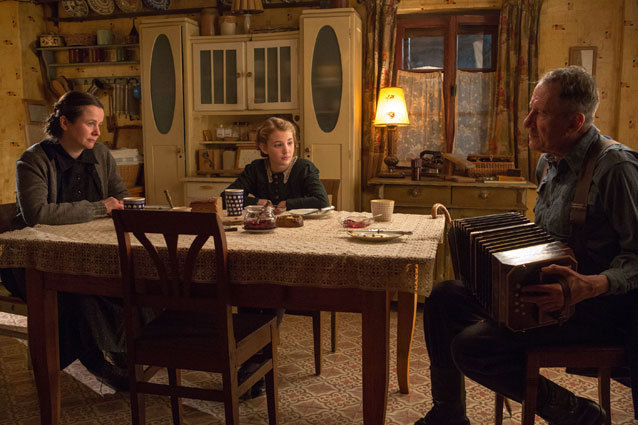
“The Book Thief” (2013) The Hubermanns’ at home
The narrative voice of Death is a teacher, a guide and storyteller. Death transcends time and place, encouraging us to think about topics in a way we are unaccustomed to, allowing the reader to learn about themselves through the narrative. It is a process with no definitive outcome. It is the punishment and reward of living, a story of hope and the beauty of mankind despite humans ability to perform such horrors and destruction.Essentially the novel is a universal book because it appeals to our human psyche, our compassion and our sense of right and wrong; of injustice. No matter our background, our situation in life or where we come from, there is undeniably something for everyone in the novel. May it be the love of books, of music, of singing or reading and drawing. Of friendship and family and laughter, the narrative voice of Death cements all together through its brilliant storytelling.
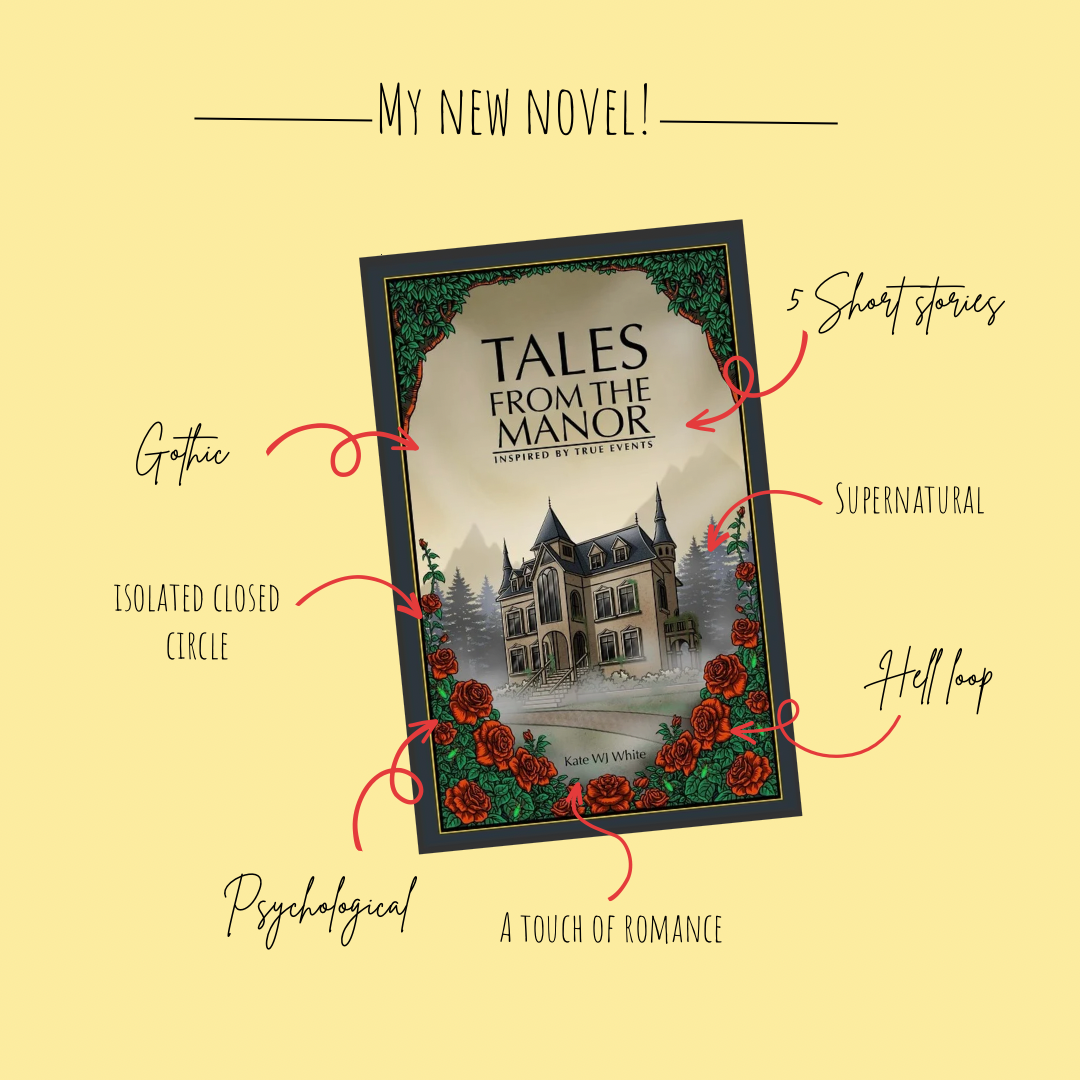
Exciting news! My new eerie short story collection ‘Tales from the Manor’ is available on Amazon! Check out my tabs above to get more info, free artwork, excerpts and more! ❤ Link below. Thank you friends.
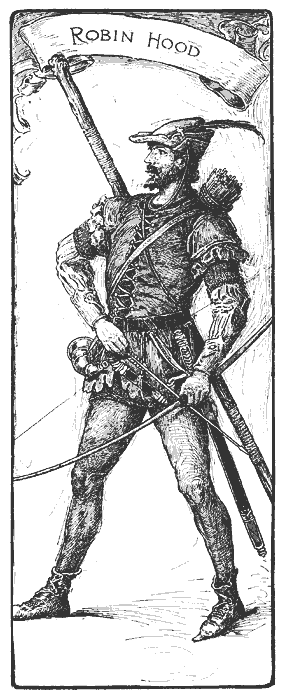
Most people remember the outlaw Robin Hood as robbing the rich to give to the poor. Yet this is only on the surface. In fact, the earlier ballads told of him doing no such thing. It was only at the beginning of the 19th Century that he has become known for this, his skill at archery- his ability to shoot arrows from a great distance to land its target and being good with the sword. Though originally he is shown as a Yeoman, (a commoner who cultivates the land) later on Robin is portrayed to have lands and position as Earl of Huntingdon, which have been snatched from him by the eager and cunning hands of the Sheriff. In the versions that followed, it is said that Robin went on the crusades to fight in the Holy War for King Richard the Lionheart. His acts of courage and battle hardy skills are all contributing factors to appoint him the leader of the outlaws.
So what do we know about Robin Hood? At first glance he is considered loyal and brave;a good leader. He would lay down his life for his men, and they for him. He does not harm women or children and always comes to the rescue at his own peril, to save those about to be executed; or hung or amputated.
No honour among thieves? Seems there is- he punishes the corrupt and is saviour of the oppressed.
In this way, Robin typically signifies a ‘concept’, a martyr of the people, those who are too weak to look after themselves and are taken advantage of by those in power and authority. The stories tell of his adventures as he one by one recruits his men, from Little John, to Allen a Dale, Will Scarlet, Friar Tuck and Much to name but a few, not forgetting his childhood sweetheart and heroine Maid Marian. In the retelling, their adventures often involve a fight in each chapter and the scrapes they get into, but Robin Hood and his merry men clad in Lincoln Green always triumph over injustice and the evil Sheriff of Nottingham.
Marian
The character of Marian is depicted a spirited and outspoken lady who, not only is good at fighting herself, but often disguises herself as a man in order to avoid detection in and out of the castle. She is seen helping those in need and acts as spy for Robin and his gang in Sherwood Forest whenever there is need.
It is interesting to see the changes made in the adaptations of the original ballad, from modern day TV series to films that tell of Robin Hood and his merry men. There have been countless adaptations which have featured the happy outlaw and cater for a modern audience.
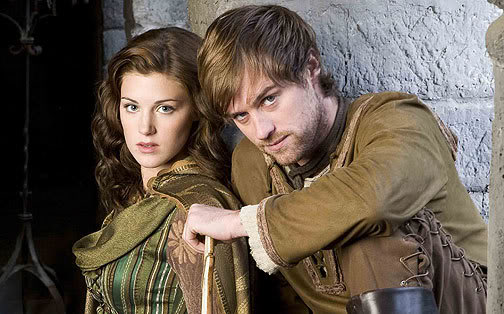
Robin & Marian (Robin Hood BBC TV Series)
For Saturday night viewers, those who remember the ‘Robin Hood’ series starring Jonas Armstrong (before ‘Strictly Come Dancing’ & the results show)- it is a family show that caters for a younger audience. Robin is in his mid 20’s, with the attractive Marian who, along with the presence of Richard Armitage as the sneering leather clad Guy of Gisbourne, was one of the main reasons I watched the show. When she left, the show introduced a variety of meaningless characters with a plot bordering on the ridiculous. They were there for the sake of being evil, but nothing could bring Marian back, and shattered all hopes of Robin and Marian being together like they should be. The show only lasted three seasons before it ended.
To act as a further comparison, later films (including Ridley Scott’s adaptation of the popular legend and ‘Prince of Thieves‘) reveal a mature Marian and Robin, supporting a different take on the ballad. A more accurate portrayal, in my opinion, of the stark and brutal reality during Robin Hood’s lifetime.
“Prince of Thieves” 1991 film
There is no denying there has always been comedy in Robin Hood. From the fierce yet frustrated sheriff who is always duped by Robin, to the adventures of the merry men whose presence it can be argued; is to provide comedic relief; there is something to make it light hearted and enjoyable for all audiences.
The fluctuation of character portrayals can be quite amazing. Let’s take Guy of Gisbourne for example.
In Howard Pyle’s “The Merry Adventures of Robin Hood”, he appears as a stranger in the forest who is killed within a chapter by Robin in a duel. In the 1956 version by Roger Lancelyn Green, he is the right hand man of the Sheriff of Nottingham, who tries to woe Marian and pursues her any chance he can get. In the 1991 Kevin Costner version (of which the sheriff is played by Alan Rickman and Richard the Lionheart by Sean Connery) Guy of Gisbourne is portrayed as the Sheriff’s cousin, whom he subsequently stabs to death when he fails to succeed in the capture of Robin.
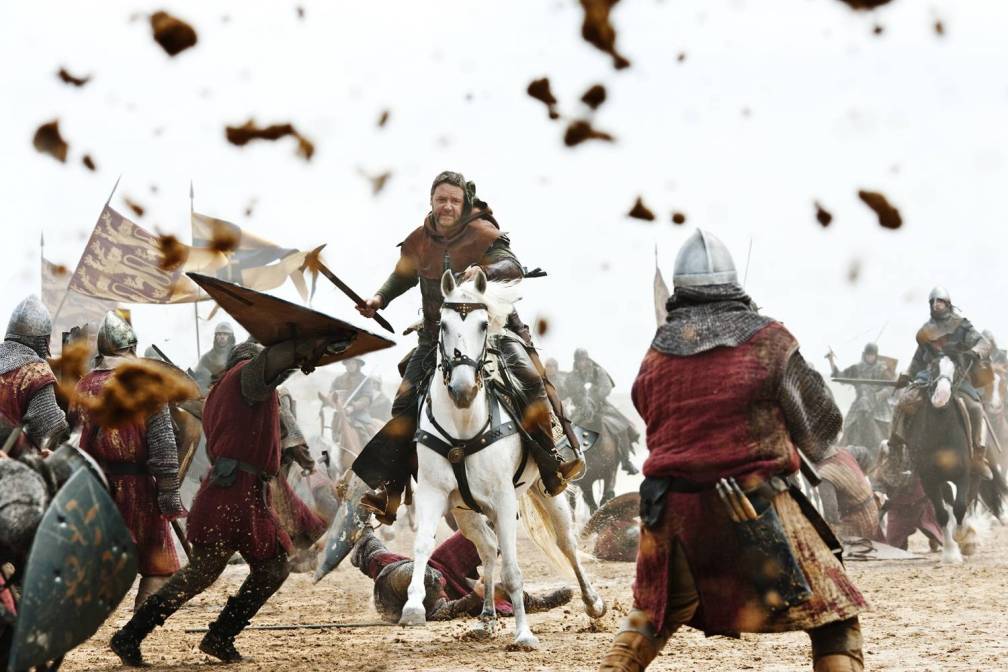
Ridley Scott’s 2010 film
Now we come to the the most recent film directed by Ridley Scott. Guy of Gisbourne does not even appear in this, and the Sheriff is portrayed as a snivelling and power hungry lacky of Prince John who hardly makes an appearance more than three times in the entire film. Perhaps this is due to the vast number of villains, with Prince John holding a prominent role, along with the new character of Godfrey.
Ultimately, whether Robin Hood existed or not matters little. The ‘idea’ of him has transcended time- a hero to represent and defend the people against corrupt lords and the law of the land, inspiring others with his spirit, to address the balance between the rich and the poor; issues which are important to this day.





 e poor. Yet this is only on the surface. In fact, the earlier ballads told of him doing no such thing. It was only at the beginning of the 19th Century that he has become known for this, his skill at archery- his ability to shoot arrows from a great distance to land its target and being good with the sword. Though originally he is shown as a Yeoman, (a commoner who cultivates the land) later on Robin is portrayed to have lands and position as Earl of Huntingdon, which have been snatched from him by the eager and cunning hands of the Sheriff. In the versions that followed, it is said that Robin went on the crusades to fight in the Holy War for King Richard the Lionheart. His acts of courage and battle hardy skills are all contributing factors to appoint him the leader of the outlaws.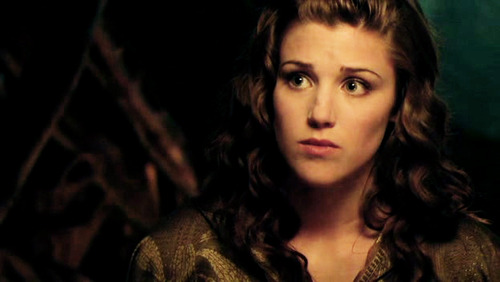

 Katewjwhite