“Nicholas Nickleby”: A Tale of Satire

swirl-divider4“I shall never regret doing as I have—never, if I starve or beg in consequence.”

Nicholas Nickleby by Charles Dickens is a story critics have until recently, found fault in. But it has remained one of the general public’s favourite. Why?

Sure it has aspects of the theatrical and flamboyant. Though critics have found the characters “one dimensional and the plot too episodic”, it had immediate success upon publication. There is something about Nicholas that makes him worthy as Dickens’s male protagonist. He has a mixture of naivety, innocence, optimism and youthful gallantry- the people’s champion through his indignation towards injustice.

Nicholas_nickleby35

Let’s look at a summary: “One of Dickens’s most flamboyant and theatrical novels, Nicholas Nickleby is the story of an impulsive young man who, forced to make his way in the world encounters human life in all its variety: the tyrannical headmaster Wackford Squeers, the tragic orphan Smike, the  ridiculous Mantalinis, the hilarious thespians Mr and Mrs Crummles and their daughter, ‘the infant phenomenon’. Nicholas Nickleby is fired by outrage at cruelty and injustice, but is above all a work filled with riotous, life- affirming comedy.”

Wow. So all that said and done, what did I think after reading it?

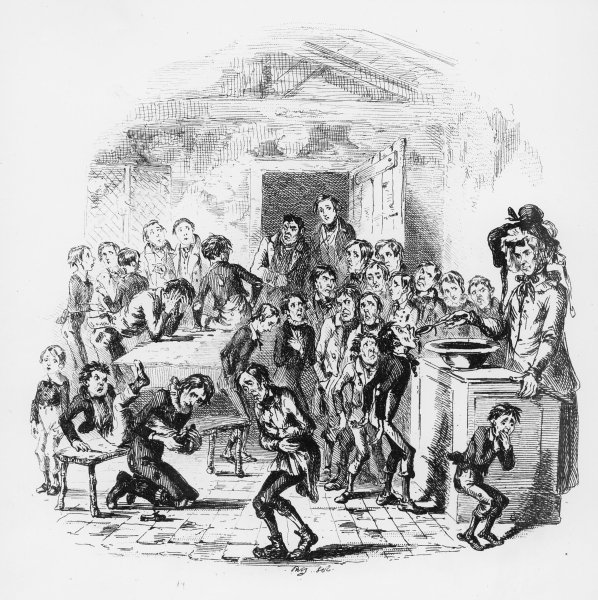
1. Sticking to this ‘outrage at cruelty and injustice’, the best example of this is through his punishment of the tyrannical Yorkshire schoolmaster Wackford Squeers. Taking up a situation as mentor/teacher without real knowledge of his situation, Nicholas witnesses the unjust treatment, starvation, illness, violent beatings and the shoddy education the headmaster preaches. In fact, Dotheboys Hall is not a real hall at all but a house with a sort of farm shed used for teaching the boys. Dickens portrays the horrors of many Yorkshire boarding schools for unwanted children (we are also brought to the attention the cruelty of “evil step parents” who sent their kids to boarding school to get them out of their lives)

Royal-Mail-Stamps-Charles-Dickens-Nickolas-Nickleby

The thrashing of Wackford Squeers, immortalised on a Royal Mail stamp

2. What makes Nicholas’s punishment of Wackford Squeers of Dotheboys Hall so satisfying is that he is not under obligation to Squeers. Nicholas is old enough to take matters into his own hands and make his mark in the world- if he chooses to. He can be impulsive and rash, but essentially he represents the voice and mind of the reader through his indignation of injustice and in this- he never fails.

3. Nicholas Nickleby is Dickens’s third novel after “Oliver Twist”. There are comparisons that can be made in his writing style and focus at the time of publication, to his later works.

4. Nicholas befriends a poor orphan named Smike- a truly tragic and heart breaking character who becomes his fast friend, escaping with him from the boarding school. Smike follows him on his journey throughout the novel.

xjf393881

The internal economy of Dotheboys Hall

5. Like many protagonists, Nicholas is under obligation to someone or another (may it be morally or financially). After his father’s death he becomes “the man of the family”, yet as a country boy in a large city and still ignorant of the ways of the world, must rely on the goodwill of others. Upon his arrival, he and his small family (consisting of mother and sister) are under obligation to his uncle. Well, we can guess how that turns out….

6. The villains in the novel are as bad as those iconic of Dickens. The cynical, miserable Uncle Ralph takes a disliking to his nephew and schemes to undermine and break him- even using his sister Kate as bait. Ralph Nickleby is a man consumed and destroyed by revenge, in which nothing can appease him.

7. The other notable character is Wackford Squeers himself. He is a deplorable and morally perverse character but the reader is often disappointed at how little he appears. The novel naturally follows Nicholas and save from various chapters where the narrative of Ralph takes over, Squeers fades into the background.

ourheritagemedia-fullsize-7c21f4887cef79d3baa7dfc5f51678a0

8. It has become a part of course really, the more I read of Dickens, for the summary to refer to each “book in question” to be the most SATIRICAL and contain Dickens’s MOST realised and comical characters. Each book claims this and well, there is truth in it. It just wouldn’t be a Dickens without them. As a writer, I only wish I could have even half the range of character development as he does…

9. Halfway through the book, Nicholas’s luck changes and so does the pace and structure of the narrative. You are still anxious for Nicholas as his enemies try to outwit and close in on him at every corner, but I found it harder to commit myself, and it took me longer to get through the book.

Nicholas Nickleby dickens-n-nickleby-4

9. I found myself getting bored with some of the events (his pursuit of Madeline Bray). In my opinion, there were characters and events taking place in “Our Mutual Friend” that kept the plot going far quicker. I can’t say I was disappointed exactly, because I was still satisfied with the ending, and how events turned out. However, some of the things in Nicholas Nickleby seemed a bit superfluous and failed to grab me like some of the other books.

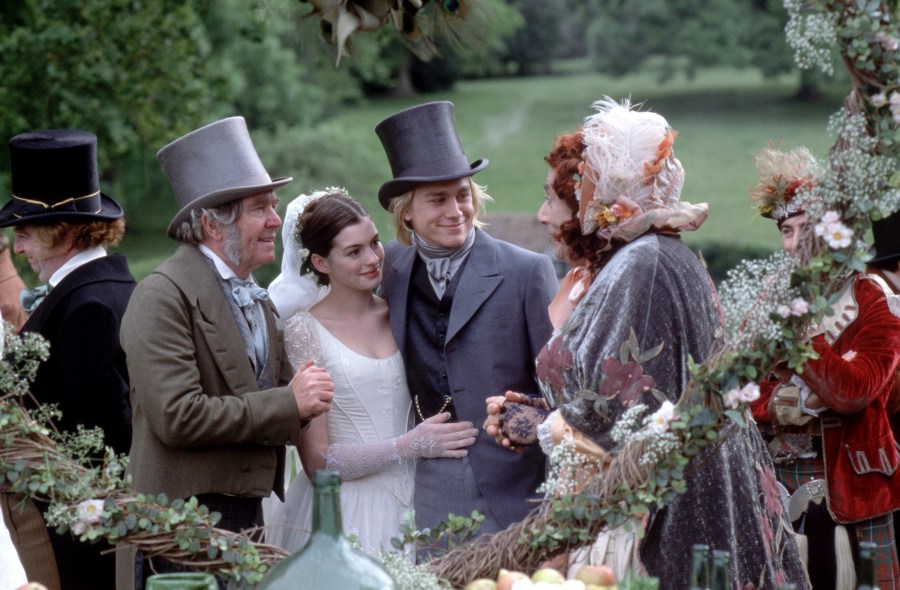
10. I saw the BBC series of Nicholas Nickleby once upon a time, and it did influence my image of Nicholas, (softly spoken, tall, gentlemanly) so this was going round in my mind while I was reading the book. Dickens doesn’t actually describe his physical appearance or even his character in detail, so it is up to us; the reader to form our own opinions. But this does not desist from the point that it is almost impossible not to love such a, dare I say it; faultless character. He will remain in the vault, as one of Dickens’s most memorable protagonists to date.

2006052515030601329325

Nicholas Nickleby 2002 film adaptation

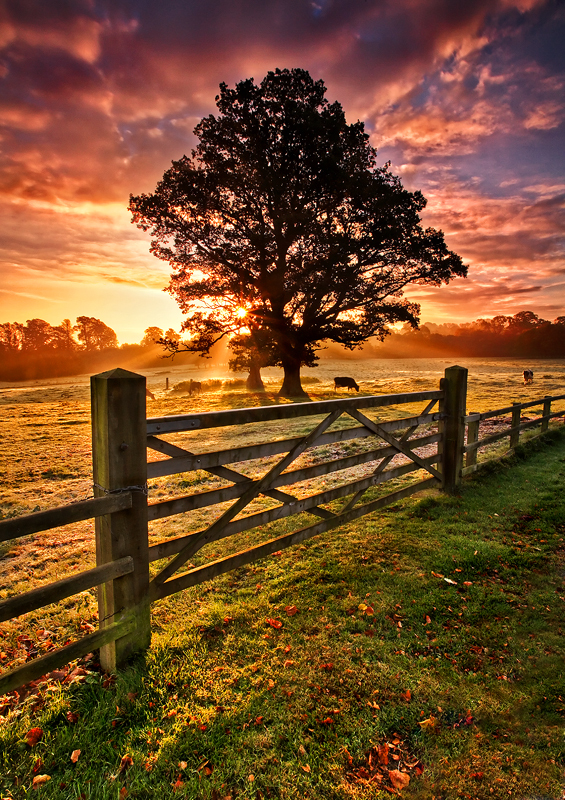
Sunrise

21257_2695047104f37e884e9526Bejewelled in the extravagance of dawn,

the light hues dabbled with a palate of gold,

caress the frost of grass with trembling breath,

orange; new born, clipping the shadows of wings,

 bringing forth the new day.

swirl-divider4

 Copyright © 2014 by Kate W J White (All Rights Reserved)

Frustration

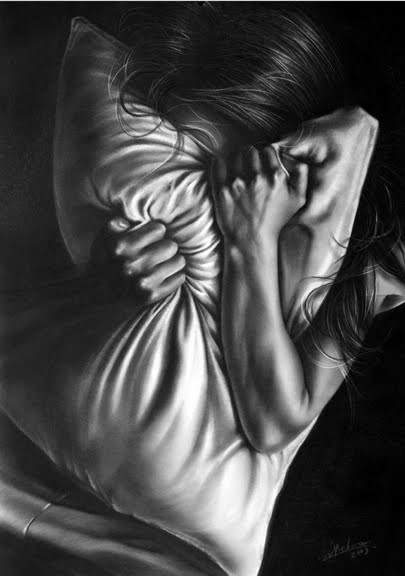
swirl-divider4frustrationFor the shouting will not stop,

lies like maggots that burrow and spawn

the devilish insides of treachery

and broken trust.

Voices; the lava that bubbles, churns and gnaws,

erodes like acid, tears at the shell

and breaks apart the fragments of brick and mortar

and the people within.

Secrecy is the glue that binds,

and honesty a beast in the shifting shadows

that dies a humble death.

swirl-divider4

Copyright © 2014 by Kate W J White (All Rights Reserved)

It doesn’t have to be boring! ~10 Tips for reading classics

swirl-divider4reading-oncosecThe first time we come into contact with classics is at school, where novels are thrust upon us. We are expected to write essays, sit exams on them, (honestly, 3/4 we don’t read but end up wiki-ing the plot.) Some of us never pick up a book again.

I am pretty sure this is not what our teachers wanted our education to lead to. The purpose of these books is to cultivate our love of reading and bring us into contact with inspirational material that will make an impact on our future lives…(maybe.)

So here are some tips that can help you with your transition to reading classics- whether you are just starting or want to get back to reading on a regular basis. So, let’s go!

il_570xN.397150200_t4n3

1) Try to get into a routine- may it be reading 1 chapter a day or every night before bed.

2) Start off with easier books. If you want to keep to classic lit, then start off with ones with simpler, uncomplicated writing styles and plot lines. Usually, we have memories of books we read at school, that have put us off evermore. This doesn’t have to be the case. NOW, nobody is forcing the books on you- and you get to choose the one YOU want to read and appeals to you.

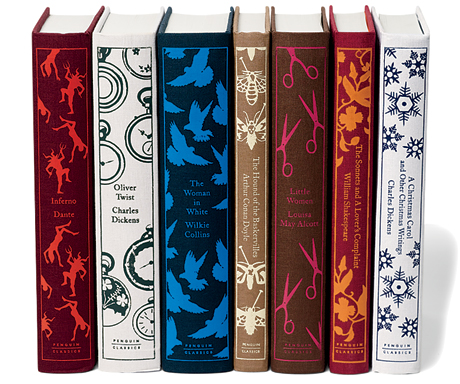
3) Genres in books are just like that of films-adventure, action, romance, comedy, sci-fi…they are endless. And this goes for classic literature too. It is hard to know the best books to read, so you can either do some research online for recommendations, or just go to the book store and read the blurb (back cover!) Imagine them screaming ‘pick me, pick me!’ Now generally, classic lit blurb’s don’t have a lot of glossing on them like many modern novels. Some editions are long (with unattractive covers) which can put you right off. But the great thing, is how publishers are ‘re-vamping’ covers making them bright, colourful and appealing that are supposed to look nice on the bookshelf- taking content aside.

Tip: Buy one with a nice cover. Yes, it is undoubtedly true you shouldn’t judge a book by its cover. But there’s no harm in choosing an edition that is attractive to you. Not only does it improve the reading experience, but also your chance of going back to it in the future, trust me.

hardcover-classics

4) Classics are easier to access- you got it, a library! Some of my best memories are of libraries- I’m not even kidding. They always have a little corner, a comfortable place to sit and get away from the world. It’s also somewhere to meet like minded people (theoretically speaking…)

5) There’s a reason why they are called classics. Passed down through the ages, they remain people’s favourites and have been so…for a reason. In some cases, you won’t agree, and think a book people champion as amazing is utter……well you get the picture. The point is that you made the effort to read it, to find out for yourself. That way, not only can you say ‘I’ve read it, and I disagree with you’, but it gives you something to talk about.

6) It might be interesting to keep an ‘old language’ vocabulary notebook. It comes in handy, and teaches you new words all the time. Words like alacrity and auspicious and sanguine. They exist, but sure, most people don’t use them any more. But treat it as a brain exercise, and it can improve your language skills- no matter which classics (or any book for that matter) you are reading.

books-girl-nature-photography-read-Favim.com-140687

7) All reading requires patience, the act of picking up from where you left off, the desire to continue reading, no matter what it is. It’s so easy to become sidetracked in the busy routine of day to day life. But a lot of things require patience, and in a society where we rely on phones, laptops, ipads etc to get by, most people would rather choose a game or watch a TV show (yes, guilty!) rather than do something more time consuming. Especially if you’ve had a tiring day at work, there’s nothing better than catching up your latest TV show rather than reaching for a book (depending also on how fast a reader you are) But that doesn’t matter. It’s the point of persevering and not giving up on a book you like.

8) Kindles and other electronic devices are taking over actual books, equalling to less of us reading hard copies. Yes this is an issue for book lovers, as nothing can beat a hard copy. There are many advantages to using a Kindle, it can store thousands of books, easy to access and bookmark, light to carry. But honestly, it doesn’t matter. As long as you’re reading something.

BOOK

9) This may be less a tip and more an observation- but keep a hard copy of the book by your bed, or on your desk, somewhere you can see it. I’m more motivated to read if there’s a book that’s there right in front of me, rather than on a kindle or other device which I can just tuck away.

10) Last but not least, why readers are scientifically proven to be the best people to fall in love with…uh huh, it’s true. Fellow book readers, this is the moment you have been waiting for…

http://elitedaily.com/life/culture/date-reader-readers-best-people-fall-love-scientifically-proven/662017/

So what do you think? Do readers make the best lovers?

And what are your reading tips?

tumblr_mw8hnfEA8I1qb0wfxo1_500

“Barnaby Rudge”: A tale of violence

swirl-divider4Dicken’s review number 2, comes “Barnaby Rudge“. It is not as famous as his other novels, and quite understated. To give you an idea of what it’s about if you haven’t read it, firstly, here is a SUMMARY:

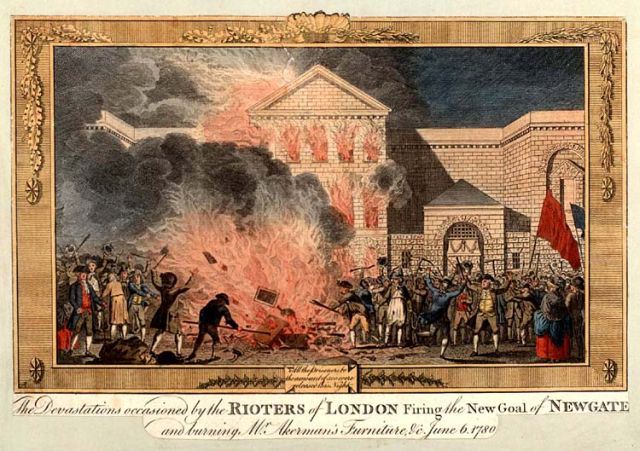
“Dicken’s first historical novel is filled with violence, looting and the terrible deaths of the anti-Catholic Gordon Riots that swept London in 1780. ‘Barnaby Rudge’ tells the story of Barnaby, a simple boy caught up in the riots, and the friends and family who are themselves affected by the strange events in Barnaby’s life, including kind- hearted locksmith Gabriel Varden, dim-witted and egotistic landlord John Willet and the brilliantly villainous Sir John Chester. This is an unforgettable novel of conspiracy, blackmail, abduction and Gothic melodrama.”

gordon-riots-newgate-prisonHere are some bite sized facts:

1. This is the 5th book Dickens wrote, after “The Old Curiosity Shop”. 

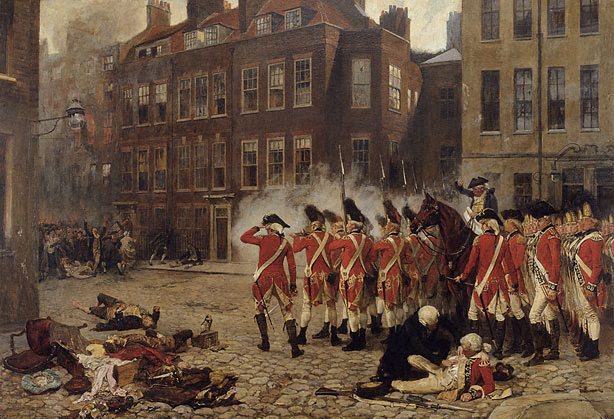
2. Like the rest of his works, it explores the inequality between social class. Ordinary citizens are seen to rise up and loot, steal, burn down houses and prisons; a total anarchy where they themselves perished- the poor, vagrants who have nothing to lose. (Those who are forerunners of the riots seem not to have a purpose for following the cause, in the case of Hugh and the hangman Dennis)

The_Gordon_Riots_by_John_Seymour_Lucas

“The Gordon Riots” by John Seymour Lucas

4. It is comparable to his later novel “A Tale of Two Cities” detailing the tumultuous period of the French Revolution and the danger of a disruptive society and mob behaviour.

5. You feel for Barnaby, a simple boy who takes comfort, joy and happiness in his surroundings. His loyalty and kind heartedness makes him a target. He follows his ‘assumed’ friend and does all he is bidden without question, hoping it will bring his mother and himself into the path of riches, and ultimately, a better life for them both. The story of Barnaby is very touching, and emphasises on how innocence can be corrupted by those with their own agenda.

10416

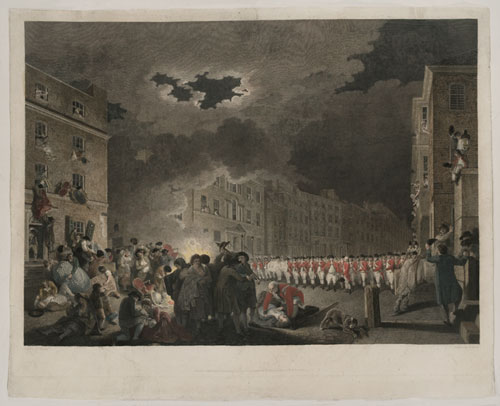
The rise and revolt of the people


6. Though”Barnaby Rudge” took me longer to read than “Our Mutual Friend” (and this can be due to other contributory factors)- I enjoyed it a lot.The beginning was quite captivating and portrays a ‘different’Dickens, a step away from the frivolity, and often comical vanity of the upper class. It creates a comparison between the peaceful, pastoral life versus that of the bloodshed in the streets of the city, sparked by the 1780 anti-catholic uprising. This was led by Lord George Gordon, leader of the Protestant Association of London. The riots were a wave that swept over London- the power of persuasion and word of mouth, growing out of proportion to make law abiding citizens rise up and revolt. The novel depicts violence fuelled by poverty and the influence of those in position who abuse their power.

7. Yet aside from all the violence and turmoil of the riots,this is a Dickens book like all the others,and his characters are no less developed. You come across characters like Sir John Chester who you really hate and whom you hope gets dealt the justice he deserves (but of course, this is a Dickens so ultimately, good always triumphs over evil) and relationships that always undergo a long, painful trial before the ‘light of happiness’ is finally revealed.

All in all, “Barnaby Rudge” is another satisfying Dicken’s novel, and the 5th one… that I have binge read over the summer!

barnaby-rudge-by-fred-barnard-1

“Our Mutual Friend” Dickens


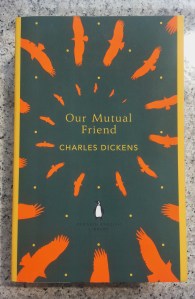
Finally, I have found time for a Dickens Review! I put these in small bite 20140804_144457sized chunks, for easy viewing…so here begins;
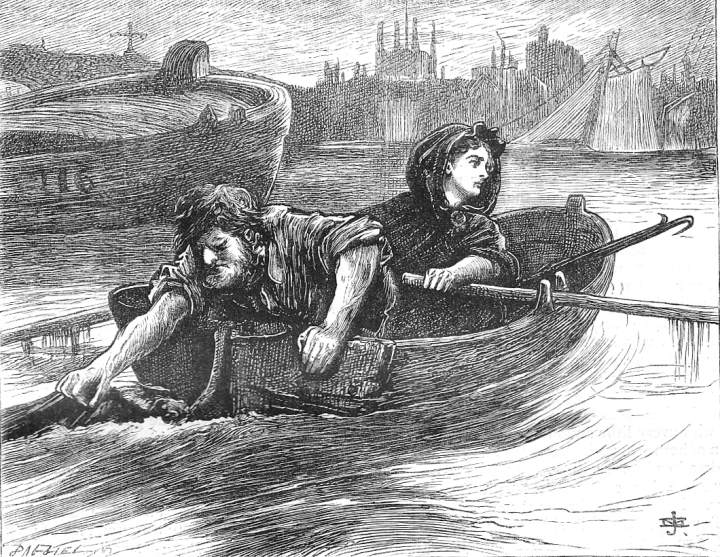
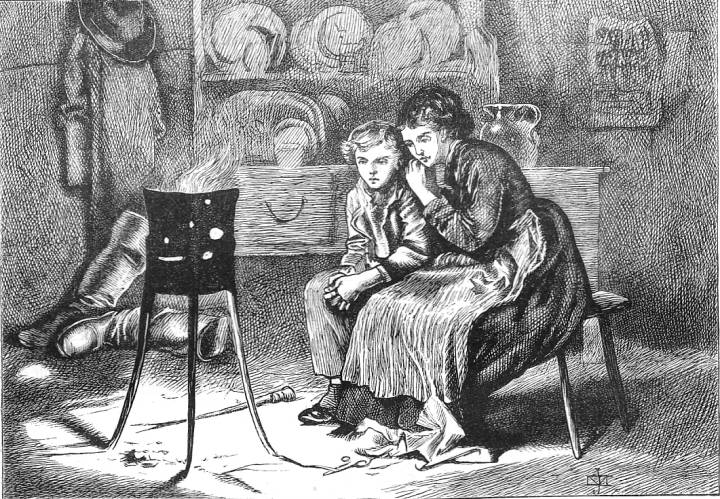
  • Summary as taken from the blurb of Our Mutual Friend: “Dicken’s last completed novel and one of the greatest books about London, ‘Our Mutual Friend‘ is a dark, enigmatic portrayal of a city corrupted by money.When a body is pulled out of the Thames, it is presumed to be John Harmon, drowned under suspicious circumstances before he could claim the fortune his father made from rubbish heaps. This mystery impinges on the lives of the naiive, hardworking Boffins, the riverside scavenger Gaffer Hexam, his beautiful daughter Lizzie, the mercenary Bella Wilfer and the doll’s dressmaker Jenny Wren, in a story of greed, death and renewal.”16

1. A dark story, it is considered one of Dicken’s most “sophisticated works”, though perhaps, one of his least well known.

2. The novel has a vast array of memorable characters which, through his wit and humour; you soon grow attached to.Though the language is less straight forward compared to his earlier novels, don’t be put off. The narrative is very well thought out and incredibly complex with intricate and unexpected plot lines. Compare the layers to an onion…

3. Death, intrigue, mystery, romance – it has everything. You are fooled along with a great number of characters along the twists and turns of a very complex narrative.Very satisfying as characters get their just rewards and no evil deed goes unnoticed, or unpunished. For me, the reading experience has to hold a variety of things, just like my favourite films. Action adventure mixed with fantasy and a bit of romance. It’s great how though Dickens manages to portray the worst of human nature in squalid London and the boundaries of social class- there is a particularly heart warming scene between John Rokesmith and Bella Wilfer that I always find myself going back to and just melts my heart (yup, I’ve bookmarked the pages)

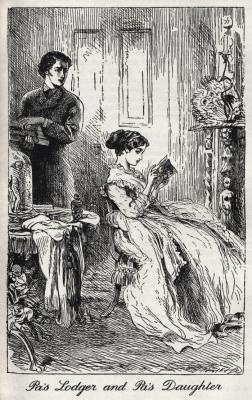
OMF-Lodger-and-Daughter4.Like each of his books, there are some great characters- no matter what shape or form they take, from the devilish and hideous dwarf Quilp in “The Old Curiosity Shop” who delights in playing tricks on others and getting the better of them, to the one legged and villainous Silas Wegg who circulates the pages of “Our Mutual Friend.”

5.However one thing about Dickens most people notice, is that his female characters are often under developed. They either hold supporting roles, as spinsters, the frugal or the vain and frivolous, or proud mothers. Young females are all dignified, elegant, pretty who undergo some tragedy or suffering which make them all the more beautiful and heroic; sought after and admired by men of all ages.

6. The illustrations are wonderfully detailed. They really bring the characters to life and gives that something bit extra to your reading experience.

177.The novel exemplifies on the corruption money can bring, the greed it excites, and how it effects the lives of those it touches.

8.After finishing the book, I thought up a hierarchy of wealth of all of the characters in the novel, taking into consideration their fluctuating social position. This may seem a bit time consuming and superfluous, but the story made me think long after I had closed its pages,(often as I was lying awake at night) and it was my way of sorting through the vast array of characters in the novel. I don’t want to give away spoilers by laying it out in all its glory. So I will let you read it first…

(Follow for more bite sized reviews on “Barnaby Rudge”, “Nicholas Nickleby” and other Charles Dickens novels.) 

Light

Dancing figures aglow

shimmering in burning starlight

wax dripping

ash like pollen, drifting

paint flecks sewing the night sky

lifting a heart’s wish.

swirl-divider4

Copyright © 2014 by Kate W J White (All Rights Reserved)

vladstudio_sky_lanterns_800x600

Scent

Shiny, bulbous like an alien capsule

with a breathing tube stabbed in liquid

drowning stem of the future

orchard floral scents splitting their leaves

in their undulating waves

crunchy skin splitting beneath your lips

-dripping into a marble.

swirl-divider4

Copyright © 2014 by Kate W J White (All Rights Reserved)

The Nine Day Queen

lady jane grey

“The Execution of Lady Jane Grey” by Paul Delaroche completed in 1833.

A Story

There’s something about it. Something…..The way her arm reaches for the chopping block, the way her dress gathers, cream satin-

This is her last moment. The priest, the executioner, her ladies in waiting but it is not their death we have come to see.

*

This beard and a brown tweed jacket thinking ‘she’s so young’, ‘how beautiful the crook of her arm’, doesn’t see the people trying to wedge themselves to his left and right because they’re all looking up into her pure little face like she’s the Virgin Mary. She has the attention of the whole court with the reach of her arm and poor Lady Jane Grey doesn’t even know because she’s blindfolded.

 
This trench coat and fur trim thinking about the executioner’s tight leggings. Eyes narrow and move from left to right, left to right, wondering why the girl in the picture is wearing a night shift and why the leggings leave nothing to the imagination. ‘If they didn’t want to ruin her lovely clothes’ she’s thinking, ‘they could have chosen a better colour than white.’ It’s cream not white. This is a big difference for someone with an eye for detail, a connoisseur of Art, but fur lady has already moved away.

 
The coffee cup Identicals thinking ‘Lady Jane is our cupid’. Looking at the girl in the painting as they bring their faces closer together, to kiss, to pull apart and look at her again, as if she would bless their union. Thinking, ‘the poor girl she will never get to experience what we have, this happiness.’ The Identicals cannot walk from the staggered weight of each other. They are blind, like Lady Jane is blind, when a painting isn’t even a painting to the couple but a canvas supported by a frame.
Mr Tie not straight, back to the portrait of the Comtesse Vilain XIIII and her Daughter. Fingers move over imaginary rosary beads, counting the structural arches of the building. Checking the phone, waiting for a business contact or client? Art related or leisure?

 
“What’s Monarchy mean? Oh….we learnt about Henry VIII but not, not Lady Jay Grey.” Says a voice then another- “Jane, she was called Lady Jane Toby.” “Mummy, what time does the Science Museum close? Because you promised.” “I told you in the car, Grandmother wants to see the paintings first…” “I know, but, but…”
Chances are they will leave within the hour.

The Science Museum. Now that was an idea. The awkward-weird-self conscious you feel going on your own, using the touch monitor sensory games with no-one to laugh with, getting lost on the top floor with no lift to take you down, you can say ‘what’s wrong with going yourself, you’re at a gallery on your own aren’t you?’ and the red dress on the bench- me, telling herself to stop being a smart arse.

“Does it even matter she was beheaded in private?” “It was a show of respect from Mary”, “So what, she was going to die anyway.” “Still…” “There is no still. Mary showed her respect by killing her sixteen year old cousin? It’s a bit late for that.” “I wonder if they saw the irony.” “What irony?” “It’s all jealousy and treachery. They are willing to kill their own family for a higher position and to be one step closer to the throne. They sacrifice their life for it. They’re brought up as kids to love the crown, to be loyal to it, to die for it. A war starts, one side loses but they go off to lick their wounds and years later they’ve got together an army, they come back stronger than ever to reclaim what has been lost. But it’s also because of family, to give your heir a better chance to succeed the throne. That’s why they fight in the first place.”

Teenagers thinking about current day politics. Teenagers hating politics, thinking, ‘there’s no telling what will happen.’

For a gallery there’s a lot of talking.

There’s another beheading in the room. It’s not the focus like Lady Jane Grey is, and the way rucksack girl looks at it and looks away instantly, is one to avoid. Red dress will tell you. It’s of the execution of Saint John the Baptist. The executioner is in the act of taking his head off with a sword. John the Baptist is kneeling on the ground holding a cross. Kid with the glasses is looking at it with interest thinking about the soon to be headless John the Baptist and the blood going everywhere and the screams of the woman in the painting, don’t forget the screams. Kid with the glasses doesn’t want to know what John the Baptist did wrong or why Herod wanted his head on a plate. The others in the gallery don’t want to know either, because they’re still looking at Lady Jane Grey.

Red dress, the last to leave the gallery, waits until the shuffle of feet find their way out into the night before looking up at the painting of Lady Jane Grey’s execution.
Finally alone with her.

The security guard is calling, “See you tomorrow. You better get on home sunshine.” He knows of her meeting with the board of directors and a delivery to supervise, so he’s trying to be sympathetic. Red dress thinking, ‘so what are your thoughts on the painting?’ but doesn’t ask. Turning off the light, locking the doors and with a smile, handing him the key she has been holding all day.

swirl-divider4Copyright © 2014 by Kate W J White (All Rights Reserved)

~ City Streets ~

city_day_and_night

Stumbling on broken petals of tarmac
The fine contours of my cheeks crack the mould
It washes the dirt from the earth
Its polluted breath
Vomits its secrecy in whiskers of black.

swirl-divider4

Copyright © 2014 by Kate W J White (All Rights Reserved)